@zachwill
I'm currently Director of Data Science for the Portland Trail Blazers. Several of my open-source projects are on GitHub.
Earth's sounds
Many of these ocean-dwelling ancients evolved sophisticated sensors for light, sound, and chemicals. But, as far as we know, they did not communicate by sound. It would take about another 200 million years or more for animals to call or sing.
Why did sonic communication take so long to blossom? We do not know for sure, and paleontologists may yet discover fossils of ancient sound makers, but it’s also possible that the keen ears of listening predators muzzled life’s sonic evolution. All of the early animal predators — arthropods and fish especially — could detect vibrations in water or, later, tremors in the soil on land. To cry out was to invite death.
No creatures sang when the seas first swarmed with animal life or when the oceans’ reefs first rose. Primeval forests contained no trilling insects or chorusing vertebrate animals. For more than nine-tenths of its history, Earth lacked any communicative sounds. Animals signaled only by catching the eye of another, or through touch and chemicals.
Cheap Turpentine
When art critics get together they talk about form, and structure, and meaning. When artists get together they talk about where you can buy cheap turpentine.
— Pablo Picasso
Then he doesn't need to be out here
“If Kobe saw that you were afraid, it’s over for you — whether you’re the teammate, or family member, or whatever,” said Brian Shaw, who joined Jackson’s coaching staff in 2005.
Many times Shaw would try to prevent Kobe from intimidating a teammate at practice. “You’re going to kill his spirit. He can’t take what you can take.”
“Then he doesn’t need to be out here,” Kobe would reply.
Subreddit
A good test of whether people are passionate about something:
Is there a subreddit for it?
— Chris Dixon
Handshake and an introduction
When everyone present has said something out loud, there is a greater chance that they will join in the discussion later. Beginning with a handshake and an introduction also immediately levels out the hierarchy to a certain extent.
In the world of compliance, this is called flattening the authority gradient. Now it’s Maria or Elliot performing the operation, not a silent artist who occasionally barks “forceps”, “swab”, and “more coffee”.
Doctors rank above nurses, who are above healthcare assistants, and so on. Just like in the military, a clear hierarchy has its benefits when it comes to making split-second life-and-death decisions. But hierarchies often interfere with optimal treatment. It’s still not unheard of for a surgeon to operate on a patient’s healthy leg by mistake or mess up a procedure without anyone stepping in.
How lucky I am
In the words of Winnie the Pooh:
“How lucky I am to have something that makes saying goodbye so hard.”
That silly old bear sure did know a thing or two about living your best life, but my guy Eeyore came up with the best quote of all:
“It never hurts to keep looking for sunshine.”
Ideal note-taking app
Every once in a while I think about how my ideal note-taking app is essentially just a really nice/flexible GUI for a SQLite database — but I don’t think anything like this exists, and I think that says a lot about the failures of personal computing.
Analogies
My basic rule is: analogies are great for a sympathetic audience and bad for an antagonistic one.
- If you’re trying to illuminate something to someone who wants to understand your point, an analogy is a great shortcut to building a tangible architecture in their mind.
- But if the other person has an opposing viewpoint and you’re trying to dismantle that and replace it with yours, analogies usually end up just moving the goalposts in the argument.
Drafting for need
One of the better NBA Draft stories:
GM Billy Knight points out that Zaza Pachulia and Shelden Williams are the only Hawks who are wide in the thighs. “They are the only two guys we have who aren’t what we call narrow butts. The other guys are thin guys, slender builds, so you need some physicality on your team.”
So he’s looking for one more wide butt?
“It depends on the butt,” Knight said. In which case Horford may well be their pick.
Area Code
In the age of cell phones, the area code has become the ancestral clan name or heraldry. It is a marker of old stories, loyalties, a statement that says “there was a land I came from but am there no longer.”
Gmail origin story
The first useful thing Buchheit built was a search engine for his own email. (And it did indeed take only a day to accomplish.)
His previous project had been Google Groups, which indexed Usenet discussion groups. All he had to do was hack Groups’ lightning-fast search feature to point it at his mail rather than Usenet.
At first, Buchheit’s email search engine ran on a server at his own desk.
— Time
Iterations matter more
The amount of iterations you have on a project matter more than the amount of time you spend on it.
Complex systems that work
A complex system that works is invariably found to have evolved from a simple system that worked. The inverse is also true — a complex system designed from scratch never works and cannot be patched up to make it work.
Mythical Big Data
Are we still obsessing over mythical big data? Because the real problem in most orgs is 50,000 very small data sets — some barely maintained — loosely tied together between Slack, Dropbox, Postgres, S3, and a bunch of Excels.
Top 5 Apps
80% of time on mobile devices is spent in apps.
85% of mobile app time is spent in the user’s Top 5 apps.
Rivers
Drinking Rivers is like if you’ve never driven a car before and someone puts you behind the wheel of a rocket ship and says, “Okay, off you go!”
More info: Grenada’s Rivers Antoine Rum Distillery
Solution Mode
Not to jump into solution mode, but did you consider adding a fourth Sign up button here?
— Jonas Maaløe on the state of Twitter UX
The oldest known building
The oldest known building is a place called Göbekli Tepe in Turkey. It’s a funny place because it didn’t have a proper roof or walls, and there’s no evidence at all that people ever lived there. Nor are there any traces of residential properties thereabouts.
This makes sense as Göbekli Tepe dates from about 10,000 BC, which is before humans settled down to agriculture. So the place appears to have been made by hunter-gatherers as a kind of temple. It’s a big place and the slabs of stone used to make it weighed up to 16 tons. So a lot of different tribes would have to have gathered there to put it all together.
There are some big stone tubs in Göbekli Tepe — the biggest held about 40 gallons — and they contain traces of a chemical called oxalate, which is formed when barley and water are mixed. When barley and water are mixed, beer quite naturally ferments. So it would appear that Göbekli Tepe was some sort of meeting place where the tribes gathered and drank beer together. It would be a pleasant place to get whiffled: top of a hill, nice view.
But it looks like there was beer, and, importantly, it looks like there was beer before there were temples and before there was farming. This leads to the great theory of human history: that we didn’t start farming because we wanted food — there was loads of that around. We started farming because we wanted booze.
This makes a lot more sense than you might think, for several reasons. First, beer is easier to make than bread as no hot oven is required. Second, beer contains vitamin B, which humans require if they’re going to be healthy and strong. Hunters get their vitamin B by eating other animals. On a diet of bread and no beer, grain farmers will all turn into anaemic weaklings and be killed by the big healthy hunters. But fermentation of wheat and barley produces vitamin B.
If beer was worth travelling for (which Göbekli Tepe suggests it was) and if beer was a religious drink (which Göbekli Tepe suggests it was), then even the most ardent huntsman might be persuaded to settle down and grow some good barley to brew it with. And so in about 9000 BC, we invented farming because we wanted to get drunk on a regular basis.
From the one fan to club president
When Brazilian soccer club Santa Cruz do Sul lost 4-1 to Grêmio in February 2012, there was one Santa Cruz fan in the stadium — a loyal 23-year-old superfan named Tiago Rech. He was pictured sitting alone in the stands, feeling the pain of a season…
When Santa Cruz won the state FGF Cup and qualified for Copa do Brasil in December 2020, it was the ultimate success for Tiago personally — for he had turned the club around as president.
“When I was around 15 years old, I started thinking about becoming a board member or even the club’s president. I always dreamt to win a title, to make the difference. From being the only fan in the stadium, to election as president, and now a champion.”
— COPA90
There are many lunatics on Twitter
There are many lunatics on Twitter. I have absolutely no idea how some of these people make it through everyday life.
— Zuby
Fractions
In everyday speech, the use of half long predated the other fractions. This is the earliest entry in the Oxford English Dictionary, from the year 835:
Charter in Old Eng. Texts 447, & him man selle an half swulung an ciollan dene.
The earliest reference to third as a fraction (as opposed to an ordinal number) is from half a millennium later: 1384.
Chicken of Tomorrow
The Chicken of Tomorrow award marked the rise of a vast new industry and the metamorphosis of the backyard bird into a technological wonder akin to missiles, the transistor, and the thermonuclear weapon — which had been tested for the first time six weeks earlier.
The winning bird was chosen not for its exotic stature or pure breeding, but for its similarity to a wax model of the perfect carcass as devised by a team of poultry scientists. The grilled chicken in your sandwich or wrap comes from a descendant of the bird that Vantress created by crossing California Cornish males with New Hampshire females.
Until the early 1950s, most US flocks contained no more than 200 chickens, about the size advocated by ancient Roman agricultural writers 2,000 years earlier. In the wake of the Chicken of Tomorrow contest, farms raised tens of thousands of birds, some as many as 100,000. A hen that might live a dozen years on a farm could now be fattened and slaughtered in six brief weeks.
The Rule of 3 and 10
One of the best pieces of advice I ever received came from Hiroshi Mikitani, the CEO of Rakuten. He said everything changes at roughly every 3rd and 10th step.
When you go from one person to three people it’s different. When it’s just you, you know what you are doing — and then you have three people and you have to rethink how you are doing everything.
But when there are ten people, it’s all going to change again. And when there are 30 people, it will change again. Same when you reach 100 people.
At every one of those steps everything kind of breaks. Everything. Your communication systems, and your payroll, and your accounting, and customer support. Everything that you put into place needs to change when you put in those three and 10 steps.
Cosmic Latte
Cosmic latte is the average color of the universe, found by a team of astronomers from Johns Hopkins University. In 2001, Karl Glazebrook and Ivan Baldry determined that the average color of the universe was a greenish white, but they soon corrected their analysis in a 2002 paper in which they reported that their survey of the light from over 200,000 galaxies averaged to a slightly beigeish white. The hex triplet value for cosmic latte is
#FFF8E7.
Zillow
Zillow made the same mistake that every new quant trader makes early on: Mistaking an adversarial environment for a random one.
The real answer isn’t “bad luck”. It’s that, despite what your models say, the market isn’t random thermodynamic noise. The market is an ecosystem — one where everything is trying to kill you all the time.
Norm
“The only thing an old man can tell a young man is that it goes fast, real fast, and if you’re not careful it’s too late. Of course, the young man will never understand this truth.”
— Norm Macdonald
Griefbacon
Helena Fitzgerald is a great writer:
The two characters from the first movie find each other again, but the point of the story is that finding each other undoes none of the losses of nine years before. They cannot ever go back to that single perfect day; even in love, you can only ever move forward.
Like a miracle, these two people locate each other again out of all the churn and unlikeliness of the whole world, but they can’t ever be with the young version of one another. The person they lost is still lost. They can’t ever have the romance they imagined having with the person they fell in love with, because that person no longer exists.
Student Height
This paper compares estimates of teacher value-added in mathematics and ELA with parallel estimates on a biomarker that teachers should not impact: student height.
Using administrative data from New York City, we find estimated teacher “effects” on height are comparable in magnitude to actual teacher effects on math and ELA achievement, 0.22: compared to 0.29 and 0.26 respectively. On its face, such results raise concerns about the validity of these models.
On Adulthood
Our first kid was born a week after I turned 27.
We got married at 23. If you had asked me at 25 whether I was ready for a kid, I would have said “No.”
That summer my dad was diagnosed with terminal cancer. That put things into much sharper focus, and it turned into a question of “If not now, when?” — so we decided to go for it.
My dad got to meet his first grandchild. Three weeks later his cancer started growing again. Three months later he was dead.
In my opinion, the greatest disservice we do to the young is shielding them from the reality that life comes to an end, and it’s going to pass by whether you are ready for it or not.
Adulthood is basically accepting that there are things you want / need to do, even though you are afraid or uncertain how they will turn out.
LinkedIn is bizarre
LinkedIn is bizarre because it tries to make this hostage situation fun. Even though it’s not. Not when you add stories, audio messages, DMs, a social feed, or anything else. The platform might be less alternate universe and more down to earth if the truth was acknowledged: performative professionalism, job hunting, and networking are extensions of work — not play.
Yes-Code Software
Software – yes-code software – has been around for a while. One of the things we’ve learned as an industry is how to write software that evolves. (We’re not perfect – sad, legacy systems still proliferate…)
We need to be able to change software to accommodate changing circumstances without rewriting it, and that is fundamentally what software engineering is: how to change software systems. Change is the name of the game.
I think no-code tools are instead an extension of a different trend: reifying workflows. Business processes and workflows used to be documented in Word docs strewn about the office or on a shared folder, or even just passed down by oral tradition in companies. Now, we have tools that allow us to build these workflows, talk about them, edit them, and share them more concretely. This is a huge boon for more repeatable business processes and for getting things done quickly! I think this is the true win of no-code tools: concretizing workflows.
Royalties, Movie Rights, and Sequels
At a recent writers’ workshop, the instructor labored heroically to keep the discussion centered upon issues of craft (as yet unlearned), while the writers (as yet unpublished) labored equally to divert the focus with questions about royalties, movie rights, and sequels.
Paradise
I have always imagined that Paradise will be a kind of library.
Averaging
One may be mystified as to why averaging helps so much, but there is a simple reason for the effectiveness of averaging.
Suppose that two classifiers have an error rate of 70%. Then, when they agree they are right. But when they disagree, one of them is often right, so now the average prediction will place much more weight on the correct answer.
The effect will be especially strong whenever the network is confident when it’s right and unconfident when it’s wrong.
Intuition
Negative intuitions are generally correct. Positive intuitions are generally wrong.
Negative intuition: “This feels off, it gives me the creeps, etc.” There’s danger outside your conscious thought.
Positive intuition: “I have a good feeling about this one, it’s a good culture fit, etc.” There’s social signaling outside your conscious thought.
Dr J on Broadcasting
Every famous athlete retires twice, first from the game and then from talking about the game… It takes a certain knack, a quickness of mind, and an ability to say nothing while sounding like I am saying something. I have to learn to speak while a producer is talking into my ear, giving me some statistics that I can use in support of a vacuous thesis about the first half of a basketball game that will be forgotten tomorrow.
I worry that I am not up to the task of explaining the essence of basketball as it is played at the highest levels. I feel that it is like trying to explain music through words or to describe a painting through text. You can give a feeling of the work, or compare it to something else, but you can’t re-create the actual feeling of being on the court, or making that move, of imposing your will, of the precise moment that you realize you can reach the front of the rim…
A subtle shift of weight, a lowering of the hands, a leaning forward, a glance, and that is enough to set off a chain of events. They are actions that stem from a thousand tiny instincts. But from where we are sitting above the court, we are unable to explain the game through these small moments, and instead talk about the Bulls’ second chance scoring and the Rockets’ bench production…
I don’t want this. I don’t want to spend the rest of my life talking about basketball.
— Dr J
Newton's Flaming Laser Sword
From Wikipedia:
Newton’s Flaming Laser Sword is a philosophical razor devised by Mike Alder in an essay on the conflicting positions of scientists and philosophers on epistemology and knowledge. It can be summarized as “what cannot be settled by experiment is not worth debating”.
From the original essay:
It seems to me fair game to use the Flaming Laser Sword on the philosopher who meddles in science which he does not understand.
- When he asks questions and is willing to learn, I have no quarrel with him.
- When he is merely trying to lure you into a word game with no prospect of leading anywhere, you have to decide if you like playing that sort of game.
Mathematicians and scientists feel that they have found a more difficult but much more satisfying game to play. Newton’s Flaming Laser Sword is one of the rules of that game.
Authoritative Parroting
This is an example of “authoritative parroting” where people simply repeat what they have heard on the topic, without actually stopping to check if what they have heard is correct. So the same misinformation is passed on, regurgitated, repeated, and made true; solely on the basis of the source, rather than whether or not it is actually correct.
The Impossible, Improbable Lottery
“Most people are never going to die because they are never going to be born,” Richard Dawkins writes, in Unweaving the Rainbow. “The potential people who could have been here in my place but who will in fact never see the light of day outnumber the sand grains of Arabia. Certainly those unborn ghosts include greater poets than Keats, scientists greater than Newton.” It’s mind-boggling to even consider. “In the teeth of these stupefying odds it is you and I, in our ordinariness, that are here.”
We have won the impossible, improbable lottery of birth. And we don’t know what will happen. We never can. There’s no skill in birth and death. At the beginning and at the end, luck reigns unchallenged. Here’s the truth: most of the world is noise, and we spend most of our lives trying to make sense of it. We are, in the end, nothing more than interpreters of static. We can never see beyond the present moment. We don’t know what the next card will be — and we don’t even know when we see it if it’s good or bad.
In 1979, Carl Sagan wrote about the awe of the universe in his notebooks, as a counterpoint to the irrationality of superstition and false belief. “We live in a universe where atoms are made in the stars; where life is sparked by sunlight and lightning in the airs and waters of youthful planets; where the raw material for biological evolution is sometimes made by the explosion of a star halfway across the Galaxy,” Sagan reflects. “How pallid by comparison are the pretensions of superstition and pseudoscience…”
— Maria Konnikova, The Biggest Bluff
Math Genius
I wish I was half the math genius a lot of people think I am — I pretty much got here with well-applied high school math.
Blogs Are Great
Web nerds in 2005: You know, blogs are great, you hear so many voices you can’t hear elsewhere. But we should get rid of the comments, they’re awful.
Social media: Got it, get rid of blogs, leave comments section.
20,000 Roam Tags with Spacy

I am not an experienced #roamcult aficionado, but I do think Roam is pretty cool.
If [[double bracket]] backlinks are what gets you in the door — then I’ve brought a
crapton of baggage with me into the doorway so far.
→ My basic idea when wrapping my head around Roam the last month:
- I really like Blinkist for book summaries.
- I really like Smash Notes and PodcastNotes for podcast summaries.
- I would love to see all the connections between the different summaries.
My General Roam Strategy
Unlike some of the more advanced Roam tutorials, I’ve actually brought a lot of my old system over with me.
→ I #hashtag quite a bit.
In general, I default to a combination of tags to keep general/interesting collections:
#interesting#quote#science
I tend to put these tags at the end of blocks:
Cool block of text goes here.
#interesting#quote
Or at the top of a page in a Keywords “attribute”.
→ I braindump a bunch of random thoughts into Daily Notes.
Kudos to Roam: it’s really the only Daily Notes system that I have felt comfortable with — even after trying to regularly use Day One, iA Writer, etc for years.
→ Tim Harford’s Messy book and Steven Whitaker’s email study influenced my ideas on folders/searching/tags/etc.
Whittaker and his colleagues got permission to install logging software on the computers of several hundred IBM office workers, and tracked around 85,000 attempts to find email by clicking through folders, or by using ad hoc methods.
Whittaker found that clicking through a folder tree took almost a minute, while simply searching took just 17 seconds. People who relied on folders took longer to find what they were looking for, but their hunts for the right email were no more or less successful.
In other words: if you just dump all your email into a folder called “archive,” you will find emails more quickly than if you hide them in a tidy structure of folders.
Adding Blinkist and podcast notes to Roam
“It seemed like a nice neighborhood to have bad habits in.”
— Raymond Chandler
Again, my basic idea after wrapping my head around Roam:
- I really like Blinkist for book summaries.
- I really like Smash Notes and PodcastNotes for podcast summaries.
- I would love to see all the connections between the different summaries.
→ How would I classify “connections between” summaries?
When I was importing my first few summaries and blog posts into Roam, I found I was most
interested in PEOPLE, COMPANIES, GEOGRAPHIES, and WORKS_OF_ART.
These all just happen to be Spacy Named Entities.
→ I like the gist of things for most podcasts.
For instance: I really like some of Scott Adams’ ideas — particularly those in How to Fail at Almost Everything and Still Win Big — but I don’t need to hear “the power of hypnosis” for the 100th time.
Automated Tagging with Spacy
→ In the end, I used Spacy for tagging PEOPLE and WORKS_OF_ART.
Spacy’s GEOGRAPHY and ORGANIZATION tagging ended up not fitting my use case — so I excluded it from the final version.
It’s pretty simple Python code for adding double brackets:
import spacy
nlp = spacy.load("en_core_web_sm")

def add_brackets_to_proper_nouns(text):
    doc = nlp(text)
    for ent in doc.ents:
        if ent.label_ == "PERSON" and " " in ent.text:
            text = text.replace(ent.text, f"[[{ent.text}]]")
        elif ent.label_ == "WORK_OF_ART":
            text = text.replace(ent.text, f"[[{ent.text}]]")
    return text.strip()
And the Roam JSON format is a breeze to create:
{
  "title": "20,000 Roam Tags and Counting",
  "children": [{
    "string": "Super simple to use."
  }, {
    "string": "Easy to create."
  }]
}
→ It’s messy, but Roam is pretty useful.
I’ve found Roam more useful reading through summaries and finding connections than the Jupyter notebooks I was using.

A Few Interesting Connections
Roam has slowed down for me (it’s obviously sluggish to get the page to load sometimes), but I have found some cool cross linking of ideas.
→ Few authors properly credit Bill Klann for Ford’s assembly line.
Henry Ford is one of the most popular individuals written about on Blinkist — but only Shortcut does a good job setting the record straight:
- Bill Klann applied the slaughtering analogy to automobile assembly lines.
- His managers weren’t even big fans of the idea at first.
Klann told Martin that his trip to the slaughterhouse had given him an idea with big potential for Ford. From a process standpoint, he explained, there was no difference between taking things apart and putting things together. So just as Swift disassembled animals on a moving conveyor, couldn’t Ford assemble things using the same, efficient method?
“If they can kill pigs and cows that way, we can build cars that way,” Klann said.
“I don’t believe it,” Martin answered.
Klann was insistent. “They made it work down in Chicago. Why can’t we put them in here for pushing the job along the same way?”
Few recognized they were witnessing the birth of a second Industrial Revolution.
→ Postmodernism kind of sucks.
A few different Blinkist summaries try to tackle why postmodernism isn’t the best philosophy, but I came away loving Alan Sokal’s hoax from Fashionable Nonsense:
The paper was entitled “Transgressing the Boundaries: Towards a Transformative Hermeneutics of Quantum Gravity” and immediately after its publication, Sokal revealed that it was full of postmodernist mumbo-jumbo that had no meaning whatsoever.
To provide evidence, Sokal used cryptically vague and obscure language in his text, such as: “the pi of Euclid and the G of Newton… are now perceived in their ineluctable historicity,” or, “the putative observer becomes fatally de-centered.”
If that sounds completely unintelligible to you, that was Sokal’s point. His hoax illustrated exactly how nonsensical certain areas of postmodernism had become.
By using meaningless jargon to form grammatically correct sentences, and being sure to cite major names in the field of physics, Sokal succeeded in getting his paper published in the fashionable journal, Social Text.
→ Intel has an interesting history — from multiple angles.
It seems like Hacker News loves High Output Management, but turns out that Intel’s history is way more interesting than Andy Grove’s management insights. Here’s a good recap from The Intel Trinity:
Unlike Gordon Moore and Robert Noyce, Grove wasn’t one of Intel’s founding members. He was an employee with a salary, and his financial stability hinged on the success of the company. This made him wary of risky strategies.
It was this fear that made him so skeptical of the company’s move into microprocessors. He wanted Intel to stick to its bread and butter, which was memory chips. Thankfully, he wasn’t able to stop Moore and Noyce, who knew the move was the correct one. Had Grove quashed the idea, Intel certainly would not have become the success it turned out to be.
→ I think I’m a gardener when it comes to notes.
There are two types of writers, the architects and the gardeners.
The architects plan everything ahead of time, like an architect building a house. They know how many rooms are going to be in the house, what kind of roof they’re going to have, where the wires are going to run, what kind of plumbing there’s going to be. They have the whole thing designed and blueprinted out before they even nail the first board up.
The gardeners dig a hole, drop in a seed and water it. They kind of know what seed it is, they know if planted a fantasy seed or mystery seed or whatever. But as the plant comes up and they water it, they don’t know how many branches it’s going to have, they find out as it grows. And I’m much more a gardener than an architect.
Sarah Tavel has brought up similar ideas in regards to venture capital.
I Also Really Like Automated Emails
I’m not solely relying on Roam for reading summaries. I’m a big believer in waking up to automated emails.
All enterprise software competes with Excel.
All productivity software competes with emailing things to yourself.
Nightly automated emails are still my main source of reading Blinkist summaries. (Along with simple CatBoost models for predicting what I like.)
The Tragedy of Life
Time makes everything mean, and shabby, and wrinkled. The tragedy of life… is not that the beautiful things die young, but that they grow old and mean.
— Raymond Chandler
Making Things Simpler
Product design is making things simpler to achieve, not adding new features.
Big Four
Over the last couple of years I’ve noticed a consolidation in programming language choice in commercial and open source projects. The software industry is always changing, but there seems to be persistent interest and investment in a few select languages: JavaScript, Python, Java, and Go — the “Big Four.”
Most People Fail
People miss the point of the “minimum viable product” for startups.
It does not mean, “release the first version with less features and then add more features later.”
No, we want a minimum viable product. The absolutely smallest set of features needed in order to get useful market information. How many features is that? Usually… zero.
An MVP can be just a slide presentation, a sales pitch, a web site, a Google ad, or a customer conversation. The best MVPs let you objectively measure customer response fast and then tweak.
One quick way to start is to make a web site that claims to offer the product you’d eventually want to build, and then gives a signup form, and then (oops!) crashes when people try to buy it (or sign up). Then make some web ads to send people there based on certain keywords.
No, not a page that says “Coming Soon!” and asks for an email address. You want a real, live, signup page for what looks like a real, live product. You can add the “it works” feature later. In the meantime, since your MVP is so cheap and fast to build, you can try lots of different ones, add and remove advertised features, and see how that changes user responses.
Once you have some input like that, you can make something slightly less minimal. Doing an MVP this way requires incredible self-control. Most people fail.
State of the Art
Most academics are still not aware that their insular “State of the Art” approaches are far short of what any Kaggle Grandmaster would do in 24 hours.
Settings Are For
Settings are for successful products. For MVPs, just get the defaults right.
Competes With
All enterprise software competes with Excel.
All productivity software competes with emailing things to yourself.
Tetris
Tetris is oddly one of the few games to accurately portray our lives.
Your accomplishments vanish but hold value, while failures pile up until a resolution is fabricated.
Washing Machines
Washing machines are robots, but they’re not intelligent. They don’t know what water or clothes are. Moreover, they’re not general purpose even in the narrow domain of washing - you can’t put dishes in a washing machine, nor clothes in a dishwasher (or rather, you can, but you won’t get the result you want).
They’re just another kind of automation, no different conceptually to a conveyor belt or a pick-and-place machine.
Equally, machine learning lets us solve classes of problem that computers could not usefully address before, but each of those problems will require a different implementation, and different data, a different route to market, and often a different company.
Each of them is a piece of automation. Each of them is a washing machine.
Rejecting the Null Hypothesis
Periodic reminder that rejecting the null (
p < .05) doesn’t mean your hypothesis is correct, it just means it’s unlikely the data came from a random number generator.There’s a lot of space between a random number generator and your favorite hypothesis…
Thanks, Dropbox
My only two requests for this version of Dropbox were for it to use as much memory as possible and somehow also be a web browser — and boy did they deliver. Thanks, Dropbox.
Things To Be Fascinated About Lottery
Somewhere in the middle of the conversation my tone switched from “Yeah, what a loser to be concerned about that kind of thing” to “Yeah, poor guy, apparently he drew the short straw in the Things To Be Fascinated About Lottery.”
Since then I have returned to the idea of this Things To Be Fascinated About Lottery a lot. There are some good draws you can get:
People who are fascinated with business — and intrinsically motivated to pursue it — only need high IQ and a few other subsidiary skills to get super rich.
People who draw math can pursue perfect pure and philosophical truth, or excel at pretty much any science they choose and advance human knowledge.
People who draw science without math have a harder time — but there are still places for them.
Then there are other people who get other straws. I’d hate to turn this into a “rank which straws are best” contest, but some certainly earn you more money, some certainly help you contribute to the future of humankind more, and some certainly land you in healthy areas of study with nice people and mostly rational thought…
iMovie 1.0
Many years later, when NeXT acquired Apple for negative -$400M, I was recruited by Steve’s right hand man to come in and build iMovie 1.0, in large part because I knew a lot about NeXTSTEP, the technology which was to become MacOS X – and because I think Steve liked PasteUp, and liked me, and thought I could get it done (we were done ahead of schedule, as it turned out).
I can still remember some of those early meetings, with 3 or 4 of us in a locked room somewhere on Apple campus, with a lot of whiteboards, talking about what iMovie should be (and should not be). It was as pure as pure gets, in terms of building software. Steve would draw a quick vision on the whiteboard, we’d go work on it for a while, bring it back, find out the ways in which it sucked, and we’d iterate, again and again and again. That’s how it always went. Iteration. It’s the key to design, really. Just keep improving it until you have to ship it.
Not Stability
Famously, Wikipedia isn’t a well-planned operation. Its salaried employees are massively outnumbered by tens of thousands of “editors” who, attracted by Wikipedia’s vision or irritated by its inaccuracies, take it upon themselves to contribute…
These contributing editors not only write articles, they also argue with each other. How should they describe controversial issues or track down hoaxes and errors? What should they do with ill-intentioned or chronically ill-behaved editors? How should they punctuate the movie title “Star Trek Into Darkness”?
Some pages urged users to be civil or to be neutral, for example, while others, written later, tried to understand what being civil, or being neutral, really meant. Some pages were concerned with truth, others with proper formatting (in case you’re wondering: Wikipedia is formally neutral on the Oxford Comma). Some talked about the importance of being polite, but others warned about how a preoccupation with politeness can undermine excellence…
One mistake I think we will avoid is the idea that social worlds evolve toward a stationary state. Whether we look inside parliament houses or web servers, we see dynamism and change: new ideas and unexpected logics of development. Some we may find silly, outdated, or even abhorrent. Others exciting, new, or perplexing.
When we study the complex patterns that emerge from human interaction, we find laws of invention, turmoil, and creation – not stability.
Five More Minutes
I was nervous. That’s a bad feeling: when you’re in the dressing room and the man says, “World Champ, you’ve got five more minutes.”
You get up and you warm up. And then you look in the monitor and you see all the people. You think about all the cities and all the world watching you. How much that’s involved. The investments you have going. If you lose: that’s going to destroy you, and everything you planned, and everything that’s involved.
And the man’s a good opponent.
You walk into the ring. You hear all these people hootin’ and hollerin’. Then you see the cameras and the lights…
I’m really frightened until the first two or three punches.
Spreadsheets
Spreadsheets really are the fullest realization we’ve seen of functional-programming-without-code — with a built-in (rudimentary) database, too. It’s no wonder they kicked off the microcomputer era and remain essential to this day.
The Right Answer for a MVP
Very frequently, the right answer for a MVP is something like an e-mail newsletter, or a Salesforce extension, or a CSV file, or an IDE plug-in, or throwing a pizza party for your target market and performing the service for them yourself.
I’ve seen startups charge $10K+/month to dump a CSV file on a client’s FTP server. Go where the user can most conveniently make use of your product; for a lot of businesses, that is neither app nor website.
Brilliant Idea
I came up with a brilliant idea for an app, did some research, and found out the same idea has already been launched, promoted, ignored by the world, and killed. Twice. By two different people. It’s a massive relief.
Reminder: trying to create an app is almost always a bad idea.
Mike Schur on Comedy
David Mamet once said: “Doing a movie or play is like running a marathon. Doing a television show is like running until you die.”
If you’re a NFL quarterback, you watch a lot of games on film, and if you’re a comedy writer you have to watch a lot of game film — you have to watch comedy, read comedy, write about comedy. You have to treat it as seriously as if you’re a law student studying for the bar exam.
Someone said the best ending for a story is at once inevitable and surprising. That it was the only way it could’ve happened, and yet the audience didn’t see it coming. I’d like every episode and every season to end that way.
Staffs should ideally be like the X-Men — lots of different, weird mutants with specific voices and talents. If everyone on your staff is an improv performer from Chicago, or a sci-fi nerd from an Ivy League school, or a stand-up, you’ll only get the specific kind of joke that group provides.
Complacency is a classic mistake. Some people get to a certain point and go, “Okay, I’ve figured it out!” Writing isn’t a thing you figure out — ever. My favorite things I’ve ever written, I hate. That might sound like a weird thing to say. But anything I’ve ever written that I felt was really great, I inevitably will look at it two years later and think, “Oh God, this is so amateurish and terrible.” But that’s a good thing. If you ever feel like you’ve solved anything in writing, you’re just setting yourself up for a huge fall — and you’re wrong. Because it’s not math or science; it’s a weird, nebulous, hard-to-define thing.
— Mike Schur, from Poking a Dead Frog
The Gym Analogy
What I’ve told people is to imagine a world where muscle is “it”.
Muscle is The Answer. Muscle is enlightenment. Muscle is what deep down every person strives for. So in that world, there are those that realize muscle is the answer, and they’ve found it.
So they write books about the wonders of muscle. They gives lectures, and teachings, and write books about what muscle does and how/why it is the answer: Be Here Muscle! Just Be Muscle! Muscle Now! The Way of Muscle!
But hardly any of these books and teachings say: Go to the gym, pick up a ten pound weight. Do 15 reps, 3 sets. They all just simply say something along the lines of: Be Muscle! Positive Thinking for Muscle!
What I’ve found in meditation is so much of what we read about being present, about non-duality, about being calm, about “positive” thinking, etc. Those are all the results, or can be the results, of putting the time in.
The gym analogy also works in regards to daily practice. If I just sit down and let my mind go about its way as it normally does throughout the day, I have to ask myself: “Just exactly what am I doing? Why am I doing this?”
It’d be like going to the gym and just kind of meandering around. Maybe picking up a one pound weight, picking my nose, sitting on a machine, and not really pushing. Just being there for an hour and saying: “I did it!”
Meditation – just like going to the gym – takes focus, direction, commitment, and honesty with yourself.
Happily Ever After
A great take on Game of Thrones…
This isn’t a story that ends with Happily Ever After. That is where we started.
This whole series is the sequel to a book never written. A classic fantasy, about heroes who fought against an unambiguous evil, about people who took their lives and their honor into their own hands and stormed the gates of the mad king. The brave hero became king and married a beautiful woman, his friend and comrade returned home to raise his family in happiness in the keep of his forefathers, and they all lived Happily Ever After.
But the brave hero doesn’t know how to rule, and the beautiful woman he married isn’t just a trophy for being a legendary hero…
Last time Happily Ever After happened, it fell apart. Because in reality, there is no end of the story. There’s just a point where the author stops writing. And if he writes long enough, everyone ends up dead. Happily Ever After is something that has never happened in real life. This isn’t a story, it’s a snapshot.
Frauds
I would say the people who are the most confident self-identifying as data scientists are almost unilaterally frauds. They are not people that you would voluntarily spend a lot of time with. There are a lot of people in this category that have only been exposed to a little bit of real stuff — they’re sort of peripheral…
The issue is that no person with a PhD in AI starts one of these companies, because if you get a PhD in AI, you’ve spent years building a bunch of really shitty models, or you see robots fall over again, and again, and again. You become so acutely aware of the limitations of what you’re doing that the interest just gets beaten out of you. You would never go and say, “Oh yeah, I know the secret to building human-level AI.”
That feels to me like the magic of AI marketing: you label something as AI and it sounds impressive, but under the hood it’s Naive Bayes — it’s whatever the simplest thing you can get up and running. And there’s a mysticism around the difficulty of the technology, even though the simplest thing gets you most of the way there.
Apprenticeship
The principle is simple and must be engraved deeply in your mind: the goal of an apprenticeship is not money, a good position, a title, or a diploma, but rather the transformation of your mind and character — the first transformation on the way to mastery.
You enter a career as an outsider. You are naive and full of misconceptions about this new world. Your head is full of dreams and fantasies about the future. Your knowledge of the world is subjective, based on emotions, insecurities, and limited experience.
Slowly, you will ground yourself in reality, in the objective world represented by the knowledge and skills that make people successful in it. You will learn how to work with others and handle criticism. In the process you will transform yourself from someone who is impatient and scattered into someone who is disciplined and focused, with a mind that can handle complexity.
— Mastery
Campfire Cooking
Getting from this first prototype to final game was a process of following what worked, and not being attached to elements that weren’t panning out. An important part of this process was showing my work to colleagues that weren’t afraid to be critical, as I lose objectivity quickly when working alone. It takes a certain kind of grit to ask for feedback at the very beginning of a project but it’s invaluable. In my case with Campfire Cooking the early feedback highlighted that I’d missed the mark with the visual style. I scrapped the darkness and slowly injected more colour into the game.
People are sometimes surprised at the games I create solo when they only see the final product. In reality each game I make is the product of many, many, many incremental improvements on repeated failures. It’s pretty much impossible to get something right the first time, or the second, third or fourth time. You have to be mercilessly objective about your own work and be willing to throw away ideas that aren’t working, or pick apart ones that have potential but also have problems. Re-engineer them, use different parts, try a different coat of paint… is the idea working now?
Your App
People don’t want to be using your app. They want to be done using your app.
Floss
People who ask about health supplements and don’t floss…
If you don’t have the discipline to floss your teeth twice a day (which has been proven beyond any doubt to be worthwhile, not only in terms of dental hygiene, but also in terms of inflammation and heart health), then how do you expect to suddenly develop the discipline to take four pills three times a day to see a small benefit?
Consistently Good
I learned a lesson: it was easy to be great. Every entertainer has a night when everything is clicking. These nights are accidental and statistical: like lucky cards in poker, you can count on them occurring over time. What was hard was to be good, consistently good, night after night, no matter what the abominable circumstances.
— Steve Martin, Born Standing Up
Checklist Manifesto
Recently finished reading Checklist Manifesto, and thought this excerpt was great:
Some years ago Geoff Smart, a PhD psychologist who was then at Claremont Graduate University, conducted a revealing research project. He studied fifty-one venture capitalists, people who make gutsy, high-risk, multimillion-dollar investments in unproven start-up companies. Their work is quite unlike that of money managers, who invest in established companies with track records and public financial statements one can analyze…
Then there were investors Smart called Airline Captains. They took a methodical, checklist-driven approach to their task. Studying past mistakes and lessons from others in the field, they built formal checks into their process. They forced themselves to be disciplined and not to skip steps, even when they found someone they “knew” intuitively was a real prospect.
Smart tracked their success over time. There was no question which style was the most effective — and by now you should be able to guess which one: the Airline Captain. Those taking the checklist-driven approach had a 10% likelihood of later having to fire senior management for incompetence or concluding that their original evaluation was inaccurate. The others had at least a 50% likelihood.
The Airline Captains had a median 80% return on investments studied, the others had 35% or less… The most interesting discovery was that, despite the disadvantages, most investors were either Art Critics or Sponges — intuitive decision makers instead of systematic analysts. Only one in eight took the Airline Captain approach. Smart published his findings more than a decade ago. When I asked him, now that the knowledge is out, whether the proportion of major investors taking the more orderly, checklist-driven approach has increased substantially, he could only report: “No. It’s the same.”
We don’t like checklists. They can be painstaking. They’re not much fun. But I don’t think the issue here is mere laziness. There’s something deeper, more visceral going on when people ask away not only from saving lives but from making money. It somehow feels beneath us to use a checklist, an embarrassment. It runs counter to deeply held beliefs about how the truly great among us — those we aspire to be — handle situations of high stakes and complexity. The truly great are daring. They improvise. They do not have protocols and checklists… Maybe our idea of heroism needs updating.
Logarithmic Time Scale
How many seconds are there in a lifetime?
10^9secondsA second is an arbitrary time unit, but one that is based on our experience. Our visual system is bombarded by snapshots at a rate of around 3 per second caused by rapid eye movements called saccades. Athletes often win or lose a race by a fraction of a second. If you earned a dollar for every second in your life you would be a billionaire. However, a second can feel like a minute in front of an audience and a quiet weekend can disappear in a flash. As a child, a summer seemed to last forever, but as an adult, summer is over almost before it begins. William James speculated that subjective time was measured in novel experiences, which become rarer as you get older. Perhaps life is lived on a logarithmic time scale, compressed toward the end.
— Terrence Sejnowski, Powers of Ten
Theory-Poor
I have always said that people are experience-rich and theory-poor, and that they have these lives that are dense with really interesting experiences. Things happen to us. Now more than ever, we’re exposed, we travel. We have these jobs that are involving and fascinating. What we lack is some way of making sense of all that.
— Malcolm Gladwell
Definitive Statements
Our greatest PR coup was a two-part one. We estimated, based on some fairly informal math, that there were about 5,000 stores on the Web. We got one paper to print this number, which seemed neutral enough. But once this “fact” was out there in print, we could quote it to other publications, and claim that with 1,000 users we had 20% of the online store market.
This was roughly true. We really did have the biggest share of the online store market, and 5,000 was our best guess at its size. But the way the story appeared in the press sounded a lot more definite. Reporters like definitive statements.
Sigmoidal
Over Thanksgiving dinner, Saul Griffith was complaining about the lack of mathematical literacy among people who should know better. “Take all that talk about the exponential growth of various web sites. Don’t people realize that those curves are actually sigmoidal?”
And of course, he’s right. These curves look exponential but eventually they do flatten out. In fact, one of the most important sigmoidal functions is the logistic function, originally developed to model the growth of populations.
Wikipedia notes: “The initial stage of growth is approximately exponential; then, as saturation begins, the growth slows, and at maturity, growth stops.” In fact, most of these curves aren’t even sigmoidal, they are sinusoidal. (This is, incidentally, why Ray Kurzweil is most likely wrong about the singularity.)
— O’Reilly
An Academic Reactor
Originally written in 1953, but as relevant to software development as anything I’ve come across:
An academic reactor or reactor plant almost always has the following basic characteristics: It is simple. It is small. It is cheap. It is light. It can be built very quickly. It is very flexible in purpose (“omnibus reactor”). Very little development is required. It will use mostly “off-the-shelf” components. The reactor is in the study phase. It is not being built now.
On the other hand, a practical reactor plant can be distinguished by the following characteristics: It is being built now. It is behind schedule. It is requiring an immense amount of development on apparently trivial items. Corrosion, in particular, is a problem. It is very expensive. It takes a long time to build because of the engineering development problems. It is large. It is heavy. It is complicated.
The tools of the academic-reactor designer are a piece of paper and a pencil with an eraser. If a mistake is made, it can always be erased and changed. If the practical-reactor designer errs, he wears the mistake around his neck; it cannot be erased. Everyone can see it.
Paraoxanase
Take a few minutes to ponder the ramifications; the food we eat may literally be making us dumber. And yes, food is a major pesticide source despite what industry might claim… The most important enzyme responsible for breaking down these pesticides in the human body is called serum paraoxanase. Some people have a lot of paraoxanase activity and are able to break down the pesticides really fast. Guess which subpopulation scientists are beginning to find has significantly reduced paraoxanase activity? People with autism.
The Correct Way of Playing
It is not even so simple, though, as to say that the “correct” way of playing is the one that wins most often, for only the dourest of Gradgrinds would claim that success is measured merely in points and trophies; there must also be room for romance. That tension — between beauty and cynicism, between what Brazilians call futebol d’arte and futebol de resultados — is a constant, perhaps because it is so fundamental, not merely to sport, but also to life: to win, or to play the game well? It is hard to think of any significant actions that are not in some way a negotiation between the two extremes of pragmatism and idealism.
Dragons
Three days after the massacre in Charleston, Colbert returned to his hometown to lay flowers at the steps of Emanuel AME and join the peace march across the Arthur Ravenel Jr. Bridge. He described it as the most moving and affirming gathering he’d ever witnessed.
“We would have done it, if we had to,” he said when I asked if any part of him had felt a desire to talk about it on the air. “But no,” he said. “It’s such an old form of a particular evil. Such a pure form, that it feels very old. It was like a dragon showed up. Like, yeah, there used to be dragons. I didn’t know there still were dragons…”
Part of the Game
As I pulled out of the Gimbels’ driveway, careful to avoid the ducks, I thought about something he said when I pointed out how weirdly even-keeled he seemed about everything. “You must learn how to lose,” he explained. “Part of playing the game is losing.”
Data Science
Some of these choices may put-off some potential readers. But it is our goal to try and spend our time on what a data scientist needs to do. Our point: the data scientist is responsible for end to end results, which is not always entirely fun. If you want to specialize in machine learning algorithms or only big data infrastructure, that is a fine goal. However, the job of the data scientist is to understand and orchestrate all of the steps (working with domain experts, curating data, using data tools, and applying machine learning and statistics).
Once you define what a data scientist does, you find fewer people want to work as one.
Jiro
All I want to do is make better sushi. I do the same thing over and over, improving bit by bit. There is always a yearning to achieve more. I’ll continue to climb, trying to reach the top, but no one knows where the top is. Even at my age, after decades of work, I don’t think I have achieved perfection.
Outcome Irrelevant
One thing that became very clear, especially after Gorbachev came to power and confounded the predictions of both liberals and conservatives, was that even though nobody predicted the direction that Gorbachev was taking the Soviet Union, virtually everybody after the fact had a compelling explanation for it. We seemed to be working in what one psychologist called an “outcome-irrelevant learning situation.” People drew whatever lessons they wanted from history.
— Thinking
Heroic Solutions
Or to put it another way: Cocoa is so very prone to have heroic solutions that require you unerringly to write heroic or at least merely mistake-less code.
Key-Value Observing. Cocoa Bindings. Retain/release. The thing they invented – ARC – to solve retain/release. Weak-referencing
selfin blocks or creating memory leaks. Autolayout. I consider myself a decent programmer, but I try to work out the complexity involved in completely implementing all-frills NSDocument loading and saving and I get winded.There are operating system kernels with lower cyclomatic complexity.
The Novice
The young are taught that Hollywood and art are antithetical. The novice, therefore, wanting to be recognized as an artist, falls into the trap of writing a screenplay not for what it is, but for what it’s not. He avoids closure, active characters, chronology, and causality to avoid the taint of commercialism. As a result, pretentiousness poisons his work.
Flappy Bird by the Numbers
After hearing about Flappy Bird the past couple days, I decided to download its 68,000 iTunes reviews last night. I explain some of the technical details down below, but I honestly don’t think that’s the most interesting story here. In fact, while the internet keeps pushing The Verge’s $50,000-a-day story about the app, I think the onslaught of Flappy Bird downloads that’s happened in the past two weeks is a much more interesting storyline.
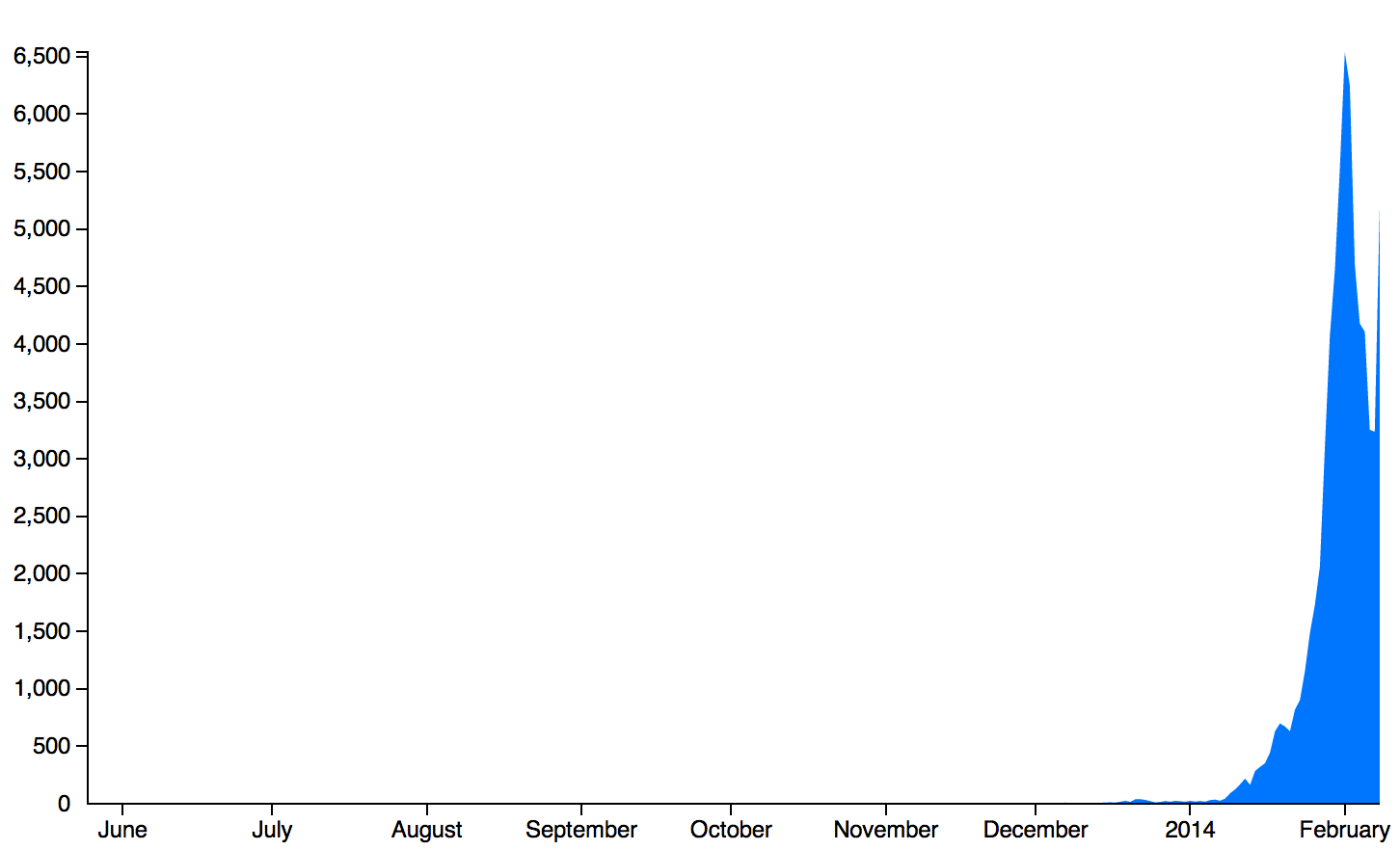
In late December and early January, I’m guessing Dong Nguyen probably used some sort of service to download/rate Flappy Bird on the App Store. The end goal was likely to generate some buzz for a game that originally had been released at the end of May and then updated in September for iOS 7. With six months of nothing happening on a game he had made in a week’s spare time, a marketing experiment around the holiday download season couldn’t hurt.
It worked. Flappy Bird started getting over 20 reviews a day (sometimes a whole 5 reviews in a single hour). At the time, this had to be somewhat encouraging. I mean, with weeks of nothing happening, 20 reviews every day from the end of December until the beginning of January had to be a good start.
On January 9th, Flappy Bird hit the milestone of 90 reviews in a single day. The experiment paid off. The game could become a niche success with thousands of downloads (approximating from review count). And, that’s the end of the story.
But wait, by the 12th, that number doubled — and by the 17th, it doubled again. The game no one cared about was up to over 400 reviews a day. On the 18th, over 600 — on the 19th, more than 680.
And, then it started to come back down to Earth. Still over 600 reviews a day on January 20th and 21st, but it had probably peaked. All good things must come to an end, right?
Except January 22nd was the first day of 100 reviews in an hour. In a single hour, 100 reviews. A new record of 800 total reviews on the day. If you keep that in mind, and use the numbers as a yardstick for what his download count must have looked like, the next week must have been absolutely insane.
On the 24th, Flappy Bird had 136 reviews submitted in a single hour — over 1,100 total reviews on the day. Two days later, on January 26th, it peaked at 206 an hour (and 1,600 reviews on the day). Two days later, 330 reviews an hour. The next day, over 400. On January 30th, more than 500 reviews in an hour (more than 4,600 total reviews on the day). On the last day of the month, more than 630 reviews in a single hour — 5,500 total on the day.
And then, February 1st hit.
You’ve got to keep in mind that this game is a Helicopter clone with Mario-inspired graphics. It was made in a single week, and largely ignored by users for months. The initial release was ignored. The update was ignored. The reviews and ratings during the holiday season were ignored.
Even after possibly using a small bot network, the total app downloads had to be relatively minor at the beginning of January. It was still going completely unnoticed on the App Store. (I’d suggest less than 10,000 iOS devices had Flappy Bird on them before January 9th.)
January 22nd Dong Nguyen was likely extremely excited about the couple months worth of revenue his marketing experiment had pulled off. With the recurring in-game ads and 800 reviews in a single day, Flappy Bird was beyond a success. Mission accomplished.
February 1st Dong Nguyen, on the other hand, must have questioned if the world had lost its mind.
On February 1st, reviews exploded to 800 in a single hour. 6,500 iTunes App Store reviews in a single day. February 1st is the day Dong Nguyen woke up, stretched, checked email, checked Twitter, checked iTunes, and witnessed millions of downloads happening.
Millions.
You can only imagine what that must have felt like.
This is the same app no one cared about for more than half a year. Just one month prior, it was a great day if Flappy Bird got 20 total reviews on the App Store. Up until January 9th, there had never been an hour in which Flappy Bird received even 10 reviews (most of the time it was under 5).
After that, the rest is history. An obscure game no one loved became the most downloaded app on the App Store (not of all time, but of the moment). The App Store even tweeted their high score. And then, he took it down.
This is less a story about a guy making $50,000 a day and more about a developer who just rode one hell of a roller coaster this past month.
Technical Notes
If you think of iTunes as a big hybrid native/web app (which it is), then it’s probably safe to assume JSON/HTML APIs exist for apps and reviews (which there are). I used Charles and wrote a simple Scrapy project to download the 68,000 reviews and user pages.
I was originally planning to focus on the December/January Flappy Bird reviews — I thought it’d be fun to prove that they were most likely bots. After loading the reviews into pandas and playing around with the data, though, it became pretty clear those had little to nothing to do with the success of Flappy Bird.
The bump in reviews on January 9th most likely started the snowball effect for Flappy Bird. I’m not exactly sure what influencer or dumb luck helped make that possible, but the 20ish reviews each day at the end of December are a pretty moot point. Diving into the numbers for the past two weeks, I’d be surprised if Dong even remembers that time. He’s seriously been on one hell of a roller coaster ride — and that ended up being much more interesting (at least to me).
Build Almost Nothing
I graduated from YCombinator a few months ago (S12 Easel). One of the most interesting parts of experience was being very close to my fellow batchmates. I was able to see in real-time and almost first-hand all the little struggles and successes. I got to see a huge variety of different skill-type distributions – some companies with all tech founders, some with mostly non-tech founders – attack their problem spaces in many different ways.
As a technical guy, watching the companies who were solving non-technical problems was particularly eye opening. I developed an extreme appreciation and respect for these hustling skills. To give an overview, their approach was generally this: build almost nothing at first (MVP!), pound the pavement and get customers to pay right away for a service they do manually, then build things to make the manual pains go away as they get more customers. It even worked for one technical team – an enterprise API. When called, the API would just email the founders, they would do the work manually, then asynchronously return the result.
This approach has wormed its way into my brain and I now think about startups in one of two categories: tech-first and service-first.
— Ben Ogle
Two, Four, Six
The first experiment I know of concerning this phenomenon was done by the psychologist P.C. Wason. He presented subjects with the three-number sequence of 2, 4, 6 and asked them to try to guess the rule generating it. Their method of guessing was to produce other three-number sequences, to which the experimenter would response “yes” or “no” depending on whether the new sequences were consistent with the rule. Once confident with their answers, the subjects would formulate the rule.
The correct rule was “numbers in ascending order,” nothing more. Very few subjects discovered it because in order to do so they had to offer a series in descending order (that they experimenter would say “no” to). Wason noticed that the subjects had a rule in mind, but gave him examples aimed at confirming it instead of trying to supply series that were inconsistent with their hypothesis. Subjects tenaciously kept trying to confirm the rules that they had made up.
This experiment inspired a collection of similar tests, of which another examples: Subjects were asked which questions to ask to find out whether a person was extroverted or not, purportedly for another type of experiment. It was established that subjects supplied mostly questions for which a “yes” answer would support their hypothesis.
But there are exceptions. Among them figure chess grand masters, who, it has been shown, actually do focus on where a speculative move might be weak; rookies, by comparison, look for confirmatory instances instead of falsifying ones. But don’t play chess to practice skepticism. Scientists believe that it is the search for their own weaknesses that makes them good chess players, not the practice of chess that turns them into skeptics. Similarly, the speculator George Soros, when making a financial bet, keeps looking for instances that would prove his initial theory wrong. This, perhaps, is true self-confidence: the ability to look at the world without the need to find signs that stroke one’s ego.
Quantity
The ceramics teacher announced on opening day that he was dividing the class into two groups. All those on the left side of the studio, he said, would be graded solely on the quantity of work they produced, all those on the right solely on its quality.
His procedure was simple: on the final day of class he would bring in his bathroom scales and weigh the work of the “quantity” group: fifty pound of pots rated an “A”, forty pounds a “B”, and so on. Those being graded on “quality”, however, needed to produce only one pot — albeit a perfect one — to get an “A”.
Well, came grading time and a curious fact emerged: the works of highest quality were all produced by the group being graded for quantity.
It seems that while the “quantity” group was busily churning out piles of work — and learning from their mistakes — the “quality” group had sat theorizing about perfection, and in the end had little more to show for their efforts than grandiose theories and a pile of dead clay.
Cowboys
Dear DeMarcus, please deliver upon us the bounty of your glorious pass rush abilities. May the opposing QB ever be weary of your imposing presence. And, by the will of the almighty Landry, may the opposing QB be destroyed by you and your brethren.
— /r/nfl
Defence Scheme No. 1
Defence Scheme No. 1 was a plan created by Canadian Director of Military Operations and Intelligence Lieutenant Colonel James “Buster” Sutherland Brown, for a Canadian counterattack of the United States.
The purpose of invading America was to allow time for Canada to prepare its war effort and to receive aid from Britain. According to the plan, Canadian flying columns stationed in Pacific Command in western Canada would immediately be sent to seize Seattle, Spokane, and Portland.
Troops stationed in Prairie Command would be sent to attack Fargo and Great Falls, then move to Minneapolis. Troops from Quebec would be sent to seize Albany in a surprise counterattack while Maritime troops would attack Maine. When resistance to the Canadians grew they would retreat to their own borders, destroying bridges and railways to hinder American pursuit.
In 1928, Defence Scheme No. 1 was terminated. While never fully justified, when declassified information about the United States’ War Plan Red was released, Defence Scheme No. 1 demonstrated the foresight of such an operation, especially in that it was prepared before War Plan Red was researched.
Space Jam
One of my favorite finds from HN comments, in a thread about the still-running Space Jam website.
I used to run the servers for this site back in 2001 and it was old then. Sad to see that
www2has still survived, that was the result of a migration off some older servers.I’m not surprised that nothing has been cleaned up, we were still running Netscape Enterprise Server about 5 years after everyone else had given up on it and moved to Apache. They had a compiled NSAPI module to serve ads through and the company had gone out of business, so we couldn’t get an Apache module.
They used to buy so many domain combinations for each new movie that we had to set up a separate cluster just to do 302 redirects to the canonical name for each, otherwise the configs became unmanageable.
— HN
Heat
“Ask them to name the starting five for the 2009 Heat.”
“I doubt they could name the starting five for the 2013 Heat.”
“Oh, that’s easy: LeBron, his friend Wade, Christopher Bush, the shorter, chubbier Wade, and then I think LeBron again.”
Advice
I only have one piece of advice for you: when the time comes, step up to the plate, smack that ball out of the park, look ‘em in the eye, and don’t say shit.
Web Apps
Web apps, or as I like to call them: skins around databases.
How Dare You
How dare you sir, demean our night of quite literal self congratulation with your extremely profitable style of offensive humor which you were specifically hired to enact and which we knowingly paid you to produce, who do you think you are, ricky gervais, wait you mean you aren’t ricky gervais, sir, how dare you, this is about art.
Realism
Stable patterns in Conway’s Game of Life are hard not to notice, especially the ones that move. It is natural to think of them as persistent entities, but remember that a cellular automata is made of cells; there is no such thing as a toad or a loaf. Gliders and other spaceships are even less real because they are not even made up of the same cells over time. So these patterns are like constellations of stars. We perceive them because we are good at seeing patterns, or because we have active imaginations, but they are not real.
Right?
Well, not so fast. Many entities that we consider “real” are also persistent patterns of entities at a smaller scale. Hurricanes are just patterns of air flow, but we give them personal names. And people, like gliders, are not made up of the same cells over time. But even if you replace every cell in your body, we consider you the same person.
This is not a new observation — about 2500 years ago Heraclitus pointed out that you can’t step in the same river twice — but the entities that appear in the Game of Life are a useful test case for thinking about philosophical realism.
In the context of philosophy, realism is the view that entities in the world exist independent of human perception and conception. By “perception” I mean the information that we get from our senses, and by “conception” I mean the mental model we form of the world. For example, our vision systems perceive something like a 2-D projection of a scene, and our brains use that image to construct a 3-D model of the objects in the scene.
Scientific realism pertains to scientific theories and the entities they postulate. A theory postulates an entity if it is expressed in terms of the properties and behavior of the entity. For example, Mendelian genetics postulates a “gene” as a unit that controls a heritable characteristic. Eventually we discovered that genes are encoded in DNA, but for about 50 years, a gene was just a postulated entity.
— Allen B. Downey, Think Complexity
Hollywood
Hollywood is a town where they honor their heroes by writing their names on the pavement to be walked on by fat people and peed on by dogs. It seemed like a great place to come and be ambitious.
Antilibrary
The writer Umberto Eco belongs to that small class of scholars who are encyclopedic, insightful, and nondull. He is the owner of a large personal library (containing thirty thousand books), and separates visitors into two categories: those who react with “Wow! Signore, professore dottore Eco, what a library you have! How many of these books have you read?” and the others — a very small minority — who get the point that a private library is not an ego-boosting appendage but a research tool. Read books are far less valuable than unread ones. The library should contain as much of what you don’t know as your financial means, mortgage rates and the currently tight real-estate market allows you to put there. You will accumulate more knowledge and more books as you grow older, and the growing number of unread books on the shelves will look at you menancingly. Indeed, the more you know, the larger the rows of unread books. Let us call this collection of unread books an antilibrary.
Nine Again
I hadn’t realized, until I was forcibly divested of it, that I’d been harboring the idea that someday, when this whole crazy adventure was over, I would at some point be nine again, sitting around the dinner table with Mom and Dad and my sister.
Noise and Meaning
We are still very close to our ancestors who roamed the savannah. The formation of our beliefs is fraught with superstitions — even today (I might say, especially today)…
This confusion strikes people of different persuasions; the literature professor invests a deep meaning into a mere coincidental occurrence of word patterns, while the economist proudly detects “regularities” and “anomalies” in data that are plain random.
At the cost of appearing biased, I have to say that the literary mind can be intentionally prone to the confusion between noise and meaning, that is, between a randomly constructed arrangement and a precisely intended message.
— Nassim Nicholas Taleb, Fooled by Randomness
Immortality
Millions long for immortality who don’t know what to do with themselves on a rainy Sunday afternoon.
Hitchhike to Alaska
This is all just to explain why, when people write me for career advice, I’m as likely to respond with something like “if I were you, I’d hitchhike to Alaska this summer instead.”
My career advice usually falls within the framework of doing the absolute minimum amount of work necessary to prevent starvation, and then doing something that’s not about money, completely outside of supporting structures, and not simply a matter of “consuming experience” with the remaining available time.
Bath
“I just took a bath, Jerry. A bath!”
“No good?”
“It’s disgusting. I’m sitting there in a tepid pool of my own filth. All kinds of microscopic parasites and organisms having sex all around me.”
Gardens
From a great comment on Reddit, discussing the site’s current “brain drain.”
It isn’t a brain drain, it’s climate change.
The bottom line is that if you want an herb garden with diversity, you need to keep the mint from taking over. If you want an herb garden that takes care of itself, don’t bother planting anything but mint, because after a couple years it’ll be the only thing left.
Iterate and Criticise
The fundamental idea here is that they’re not doing it once, they’re iterating over it, and criticising it. And that’s a key term. Iterate and Criticise. Michael then used Brad Bird’s anecdote of Gower Champion, the theatre and film director of the 30s, who walked into a theatre to see the cast just standing around on the stage, the choreographer just sitting there in the second row with his head in his hands. Gower goes “What’s going on?” “I just don’t know what to do next”, the choreographer goes. Gower replies “Well do something, so we can change it!”. And that’s a fundamental Pixar idea, just keep moving, just keep trying, and something will come up.
Half
I feel like half of being an iOS developer is figuring out how to fuck with UIKit.
Unfair
How do you, when given an unbalanced (otherwise known as unfair) coin, produce a fair result?
I was seriously at a loss as to how to even approach this problem without any type of probabilities or statistics, but then stumbled across the answer on this blog.
It turns out to be fairly easy. Just follow these steps:
- Flip the coin twice.
- If both tosses are the same (heads-heads or tails-tails), repeat step 1.
- If the tosses come up heads-tails, count the toss as heads. If the tosses come up tails-heads, count it as tails.
To see why this method makes even a biased coin fair, let’s pretend we have a weighted coin that comes up heads 60% of the time. If you toss it twice and throw out the result when both tosses are the same, you’re left with two possible outcomes. The probabilities of the two remaining outcomes are the same.
P(HT) = P(TH)
P(H) * P(T) = P(T) * P(H)
0.6 * 0.4 = 0.6 * 0.4 = 0.24
Since both outcomes have exactly the same probability, the bias is removed. This method will work no matter how biased the coin you use, as long as there’s some possibility of it coming up either heads or tails (so no two-headed coins allowed).
This is easily one of my favorite brain teasers.
Flask/iOS screencast
Thought I’d make a quick screencast showing how to use the Ground Control library with a Flask application running on Heroku.
objc_msgSend
In which Mike Ash blows my mind, by implementing objc_msgSend in assembly:
The need to go fast becomes much less important at this point, partly because it’s already doomed to be slow, and partly because this path should be taken extremely rarely. Because of that, it’s acceptable to drop out of the assembly code and call into more maintainable C.
Quiet Car
When the train came to my stop I had to walk by his seat again on my way out. “Glad we could come to a peaceful coexistence,” I said as I passed. He raised a finger to stay me a moment. “There are no conflicts of interest,” he pronounced, “between rational men.” This sounded like a questionable proposition to me, but I appreciated the conciliatory gesture. The quote turns out to be from Ayn Rand. I told you we talked like this in the Quiet Car.
Permission To Suck
What they didn’t understand — what most people don’t understand, is that someone doesn’t wave a magic wand and make you successful or good at something. You don’t just head down to the career center at your community college and fill out an application to be a successful entrepreneur, or a famous musician, or a professional basketball player.
You have to give yourself permission to suck first.
Most Everything
Most everything is download stuff from the network, store it in Core Data, and display it in a table view. Make a few custom controls here and there or some fun animations. That part is fun, but that’s a small part of it.
Compromise
The question is, really, what are you not willing to compromise on?
Good. Cheap. On-time.
Now, that makes it easy and says there are only three factors, but, in the real world, there’s many, many, many, many real factors. But, I think however many aspects of a project there are, the only way to really get it done is to have one of them that your group, your team, your whatever — yourself, if you’re doing it by yourself — is the main one. Right? You’ve got to pick one, and that’s the thing you hang on to, and you do the best you can with the other ones. The one thing you’re not going to bend for, right?
That’s the difference between Apple and Microsoft — the one thing they’re going to hang on to.
With Apple, it’s user experience. That comes first and everything else — everything else — follows after that. It’s always been like that, right? They’ve maybe fallen short at times, but what they’ve always tried to do is make the best experience possible. How it feels to use. How it looks. How elegant it is. What it feels like. Now, what it’s like to buy it. What it’s like to open the box. Right? It’s always about the experience.
It’s not that Microsoft doesn’t care about the user experience, it’s just never been first. I think first has always been that mantra “Windows everywhere.” Right? It’s to get it everywhere, and to get as many features in, and keep as many features in, so that anywhere that they might be able to use it, you can say, “Yes, you can use it.” And, not necessarily that you should, but you can. And, that’s their one thing they hold on to.
Dogs
He is my best friend, and I am his, but he will go to his grave having never known my name.
One Little Pointer
Every Objective-C object must begin with an
isapointer, otherwise the runtime won’t know how to work with it. Everything about a particular object’s type is wrapped up in that one little pointer. The remainder of an object is basically just a big blob and as far as the runtime is concerned, it is irrelevant. It’s up to the individual classes to give that blob meaning.
— Mike Ash
Tumblr for iOS
Update: Tumblr for iOS is now completely native.
After updating the Tumblr application for iOS (and coming across Peter Vidani’s Dribbble shot), I decided to take a stab at seeing how it worked. I ended up using both Crunch (for resource files) and Charles (for network traffic). There’s no real voodoo involved to see how things fit together — most of what I did is covered in this NSScreencast episode.
The first thing you notice when looking through Tumblr’s source
files? 26 different Mustache templates. Yeah, 26 —
and all end with a .html extension.
I really hadn’t noticed that the timeline was one big UIWebView when first
playing around with the app — in fact, for awhile (even after finding the
templates) I thought maybe each post in the timeline was its own UIWebView
held inside a native container. Credit where credit is due, it’s an incredibly
nice web interface.
Since all the CSS and JavaScript files are included in the source, I thought it was weird that Mustache.js wasn’t included — and both spin.js and Zepto were — but it actually makes a lot of sense. Behind the scenes, the app’s obviously using the Tumblr API, but the API actually has total control over how the timeline looks and feels. So much so, even the highlighted ribbons in staff posts are done via the API:
{
  "highlighted": {
      "message": "Now presenting...",
      "icon": "http://assets.tumblr.com/unicorn.png",
      "color": "#498acc"
  }
}
The API sends 20 resources at a time (posts from users you follow) for the home
timeline. Mustache templates are then used (probably with
GRMustache) to create the initial HTML
document. Based on some of the comments in the app’s JavaScript files (which are
incredibly well-commented and easy to read), native code is used to
detect how far the user has scrolled.
Once we reach the end of those 20 posts, the API sends 20 more, which go through
the Mustache templates to become HTML, and JavaScript is used to append those to
the current timeline. The downside to this approach (and I’m sure the engineers
are aware of it — the available code is really well-written) is when a
user agressively tries scrolling through the timeline. Frame rate drops pretty
significantly and scrolling begins to feel sluggish — native containers
like UITableView have had hundreds (if not thousands) of man-hours spent on
performance and cell reuse for this exact scenario.
While most users won’t ever notice this — I mean, it took me a couple
hours to realize it was a single UIWebView even after seeing the static source
files — there is another downside. Whenever the user goes back through the
timeline a signifcant amount and then exits the application, it can take a
really long time to reload. The UIWebView basically has to render the giant
HTML timeline again.
But, this post isn’t about a native versus HTML approach, and I’ve got to admit, it’s pretty cool seeing how well the API and Mustache templates mesh together. Basically the entire “logic” behind how the home timeline is displayed exists in the interaction between the two.
Another interesting find was the lack of .nib files (which is actually the
opposite of Airbnb’s source). Native UIView files are obviously used
when the user begins writing a post (along with a really nice tab bar
animation), and are probably written in code. One comment in the
Update: the Storyboard comment actually
refers to
storyboard.tumblr.com.Post.css file indicates Storyboards are in use or will soon be used
sometime in the future.
For Future Bryan, this is to make Storyboard interviews look right.
Another great takeaway was how the engineers target Retina devices in CSS:
@media only screen and (-webkit-min-device-pixel-ratio: 2) {
    /* Retina CSS */
}
Moving on to other parts in the application, I’m inclined to believe that
pull-to-refresh is native (and, as a side note, I really like the use of images
throughout the UI rather than text). There are also two Core Data .momd
directories included in the source, one of which is named STPersistentCache.
After some light testing, I’m pretty sure STPersistentCache caches images
locally after they’ve come across the network twice (at least this was the case
with larger images — which no longer came over the wire). It actually
makes a lot of sense when you think about it: some of the images in the timeline
(or other views) will never be accessed again, but those that have been accessed
two or more times must be somewhat pertinent to the user.
The other .momd includes 20 entities that make up the basis for the types of
posts a user can make, etc. One of the newer entities is FanMail — which
has accompanying images in the source — but I was unable to find it when
playing around with the app (although, I haven’t interacted with fans on
Tumblr).
Some other notes include Tumblr’s use of Flurry for
analytics (sends on applicationDidEnterBackground — standard stuff).
Also, the minimum version supported is iOS 5.0 (checked Info.plist).
Lastly, I could be completely wrong about some of these details. Crunch and Charles are great tools for seeing assets and network traffic, but they’re not exactly a view source into Tumblr’s Objective-C code. I can say the CSS and JavaScript are incredibly well-written code — within only a couple hours I was able to see how things fit together.
100 Bad Projects
An artist friend of mine once relayed to me a quote:
“Everyone has 1000 bad drawings inside of them. The sooner we get those out, the sooner we can start making better drawings.”
The same holds in programming. Maybe 100 bad projects but there is nothing you can do but get them out of you.
Between my work, homework, and research I was probably at about the 100 project mark when I started be a little less confused about what I was doing. There is nothing I can press more on the new learner than to try and push through these 100 projects as quickly as possible.
Readability
If I think about Readablity too much, I get kind of sad.
Design Guy
Nick is a design guy and it makes sense that Craigslist would horrify him — “it feels stuck in the 1990s, where links are electric blue and everything is underlined.”
But sometimes design doesn’t matter, even though that thought scares the hell out of designers.
— Craigslist (and Silicon Valley) Greatly Offends the NY Times
Mobile Development
I think there’s far more low-hanging fruit in making native development easier than in making web/hybrid apps feel “right”. I’ve seen two just good hybrid implementations (Quora and Pocket), and yet I still run into defects using both.
— Clay Allsop, The Shape Of Mobile Development To Come
Reggae
It is mentioned in the Bible that there will be a music, and all people of all global concern shall play, and dance, and sing this music. It’s in the Revelation. What type of music could that be? Reggae.
Combined Hours
Here’s a little secret that often gets overlooked: a lot of the cool UI elements you see are stock Apple elements that have been customised to the brink of no return.
The main reason for this is Apple has put a lot of time and effort into making components that just plain work. A UIScrollView, for example, has had many more combined hours of testing than any app you write could hope to achieve.
I've Got An Idea For An App
“I’ve got an idea for an app” is the new “Will you read my screenplay?”
Ron Swanson
If I wanted to bring a large amount of deviled eggs, but I didn’t want to share them with anyone else, could you guarantee me fridge space?
It's Not File Size
Occasionally I would hear a publisher talk about what their readers wanted, but it was always under the guise of some gimmicky new feature that might get them some press attention and rarely about the core content.
Why
when you don’t create things, you become defined by your tastes rather than ability. your tastes only narrow & exclude people. so create.
Einstein
We can’t solve problems by using the same kind of thinking we used when we created them.
Programming Languages
I just realized I hate all programming languages.
Silence
In the end, we will not remember the words of our enemies, but the silence of our friends.
— Martin Luther King, Jr
The New File System
What this really means is that users of web apps (specifically small business) don’t need to struggle with your crappy UI, and you don’t need to reinvent the spreadsheet to unlock powerful new interactions and possibilities. Holy shit. Do you see it? Is it coming to you now?
Imagine: your customer can modify web app data in their desktop app of choice.
Example: Jimmy runs a small e-commerce business. He’s not a technical person and understands little about how the web functions. He typically puts internet passwords on sticky notes around the office, and gets frustrated when he needs to find one. However, Jimmy spent 12 years prior working for a financial services firm, and knows how to mash up data in an excel spreadsheet like you wouldn’t believe. With Dropbox and a smart web app, Jimmy gets to manage all of his e-commerce product information in a local excel spreadsheet, sitting in that magic box on his desktop.
Duty
“That’s the duty of the old,” said the Librarian, “to be anxious on behalf of the young. And the duty of the young is to scorn the anxiety of the old.”
They sat for a while longer, and then parted, for it was late, and they were old and anxious.
— Philip Pullman, Northern Lights
Spreadsheet
I realized I was just being lazy and cargo cultish.
“I have data. Seems like it would go in a spreadsheet. So let’s use a table. And of course it should have sortable columns because that’s what spreadsheets have.”
All this got me thinking about if I’m truly designing a solution to a problem if all I’m doing is replicating the features of a spreadsheet in a web app. Why wouldn’t a user just use a spreadsheet then?
Small Business
A lot of small business owners are going to start running their businesses from their smartphones.
Idiot
The available evidence seems to indicate that at some point, Reed Hastings was a smart guy. Smart enough to count to twenty with his shoes on. Smart enough read pages 1-15 of the kind of introductory strategy text where they solemnly tell you to figure out what business you’re really in. Smart enough to grind Blockbuster into a pile of gleaming blue-and-white sand while launching a streaming service so popular that it now accounts for something like 20% of peak-load internet traffic. If you want to write an article on how he’s a big fat idiot who couldn’t find his ass with both hands in the dark, then you should probably have a theory of the transition between these two states of Reed Hastings. Did he suffer a stroke? Start dating distractingly gorgeous supermodels? Has he been licking the paint chips in his gloriously restored Victorian mansion?
If you do not have a theory—if you believe that Reed Hastings just suddenly and for no apparent reason became an idiot—then one of two things is likely. Either there is some undiagnosed medical condition that Mr. Hastings’ doctor should investigate immediately, or you are committing the fallacy of Chesterton’s fence.
Tools
Then everybody has to update the spreadsheet. Notice how the focus has moved. Instead of sitting in a room doing other things while the status of our project beckons us on the wall, we’re sitting in our cubicles filling out a spreadsheet once a day. The focus is on remembering to update a tool, not thinking about the status of our project. The tool starts running the project. It becomes the central source for finding out things. Not the people.
If we’re not lucky somebody writes a check for a more “powerful” tool. “Powerful” Agile tools usually have all sorts of fields, checkboxes, and whiz-bangs. They promise all kinds of benefits for teams — track your actual time! Track code changes against tasks! Roll up dozens of projects in a single bound!
There are people who love tools. These are the people who build them, sell them, or have a full-time job to maintain them. To them, tools are the answer to everything. How could you not love something that organizes so much data so easily? Weird thing — these people are also not the people who are actually doing the work.
Otherwise Do Something Else
In 1995, I was a graduate student studying philosophy at Columbia. I was also doing computer programming on the side. The programming was going well and I was getting some good job offers. I happened to get to have dinner with the philosopher Daniel Dennett, and I asked him what he thought I should do with my career. He said: “If there is absolutely no way you can imagine being happy except studying philosophy, study philosophy. Otherwise do something else.”
I’d say the same thing about starting companies.
Machiavellian
Fallon in Minneapolis started out with a clear if Machiavellian business development program: do work for small, appreciative clients (hair salons, restaurants, muffler shops, etc.), dominate awards competitions, and parlay that fame into bigger, more visible accounts. It worked remarkably well. So well, in fact, that the rest of the industry followed its model. And it worked again (Chiat). And again (Goodby).
Interruption Marketing
That’s interruption marketing. It’s you paying money to stop me from doing what I want to do, so you can try to sell me something I don’t need. I don’t get that world. I never got that world.
Hypercard
And if you think that Xcode, Python, Processing, or the shit soup of HTML/JavaScript/CSS are any kind of substitute for Hypercard, then read this post again.
Typography
To choose a width of column which makes the text pleasant to read is one of the most important typographic problems. The width of the column must be proportioned to the size of the type.
Overlong columns are wearying to the eye and also have an adverse psychological effect. Overshort columns can also be disturbing because they interrupt the flow of reading and put the reader off by obliging the eye to change lines too rapidly. Lines which are too short or too long reduce the memorability of what is read because too much energy has to be expended. There is a rule which states that a column is easy to read if it is wide enough to accommodate an average of 10 words per line. If the text is of any length, this rule is of practical help. A small amount of text can be set in long or very short lines without disturbing the reader.
Sufficient leading between the lines is of the first importance for easy reading. If the lines are too closely set the eye is forced to “take in” the neighboring lines while reading. Anything that might impair the rhythm of reading should be scrupulously avoided.
Learning
One of the interesting things about picking up the drums was that I realized it had been some time since I had actually tried to learn something new. We spend most of our childhoods learning new things. But as you get older, the frequency with which you develop new talents slows down. Sometimes it stops completely.
Before
Before writing, communication is evanescent and local; sounds carry a few yards and fade to oblivion. The evanescence of the spoken word went without saying. So fleeting was speech that the rare phenomenon of the echo, a sound heard once and then again, seemed a sort of magic.
— James Gleick, The Information
On Jobs
Steve and I were talking about children one time, and he said the problem with children is that they carry your heart with them. The exact phrase was, “It’s your heart running around outside your body.” That’s a Steve Jobs quote. He had a level of perception about feelings and emotions that was far beyond anything I’ve met in my entire life. His legacy will last for many years, through people he’s trained and people he’s influenced. But what death means is you can’t call—you can’t call him. It’s a loss. I’ll miss talking to him.
Fight
The fight’s only interesting if people show up.
— Don King
More Like Bands
Web development shops should be more like bands and less like companies. We get together, collaborate on this site like an album, and then go our separate ways or stick together afterwards.
Seinfeld
I can’t drive and argue with you rubes at the same time!
— Kramer, The Muffin Tops
Creativity
One of the foremost building architects of the twentieth century, Louis Kahn, offers a useful explanation of the relationship between beauty and design: “Design is not making beauty; beauty emerges from selection, affinities, integration, love.”
Kahn explains that beauty emerges from selection. That is, art comes not so much from the act of creation itself but rather from selecting among a near infinite supply of choices.
The musician has a near-infinite palette combining different instruments, rhythms, scale modes, tempo, and the hard-to-define but easy-to-sense “groove.” The painter starts with some 24 million distinguishable colors to choose from. The writer has the full breadth of the Oxford English Dictionary (all 20 volumes; some 300,000 main entries) from which to select the perfect word.
Creativity comes from the selection and assembly of just the right components in just the right presentation to create the work. And selection — knowing what to select and in what context — comes from pattern matching, and that’s a topic to which we’ll keep returning.
Ads
But, in fact, the audience has probably seen a number of those ads six, seven, eight times. They’ve only seen the film one time. The ads are actually text they know much better — that they have a much better command of, in terms of the repertory of what they’ve seen and how they understand the medium — probably than the feature film.